910-279-9398 Download Our Brochure
  • Homes for sale in coastal southeastern NC

Archive for the ‘Housing Market Updates’ Category

How Supply and Demand Can Impact Your Buying and Selling Goals

Posted by

How Supply and Demand Can Impact Your Buying and Selling Goals | Simplifying The Market

In today’s housing market, there are far more buyers looking for homes than sellers listing their houses. Based on the concept of supply and demand, this means home prices will naturally rise. Why is that? When there are more people trying to buy an item than there are making that item available for sale, that drives prices up. And that’s exactly the case in today’s housing market. So, knowing what’s happening with the inventory of homes for sale and the demand for housing is crucial for today’s buyers and sellers.

Nationally, Demand Is High and Supply Is Very Low

The latest buyer and seller activity data from the National Association of Realtors (NAR) indicates buyer traffic heavily outweighs seller traffic today, as shown in the maps below. There are far darker blues (strong buyer activity) on the left and much lighter blues (weak seller activity) on the right. In other words, this shows how the demand for homes is significantly greater than what’s available to purchase.

How Supply and Demand Can Impact Your Buying and Selling Goals | Simplifying The Market

What Does This Mean if You’re a Seller?

Supply is struggling to keep pace with demand. In fact, the inventory of homes for sale recently hit an all-time low. That gives you an incredible advantage when you sell your house. With so few listings, it’s likely more potential buyers will view your house – especially if you work with an agent to price it right. That means there’s a high chance you’ll receive multiple offers or buyers will enter a bidding war for your house. And that dynamic can drive the sale price of your home up.

What Does This Mean if You’re a Buyer?

As a buyer with fewer options available, you’re likely to see more competition, so you need to be strategic to win. First, make sure you have a trusted professional on your side. Your real estate agent will help you understand your local market and work with you to act quickly when the time is right. Even when it’s challenging to find a home, you can still succeed as a buyer today if you have a trusted advisor on your side every step of the way.

Bottom Line

Whether you’re a homebuyer, seller, or both, knowledge truly is power. Let’s connect today so you can better understand what’s happening in our local market and achieve your homebuying and selling goals this year.

Real Estate Voted the Best Investment Eight Years in a Row

Posted by

Real Estate Voted the Best Investment Eight Years in a Row | Simplifying The Market

In an annual Gallup poll, Americans chose real estate as the best long-term investment. And it’s not the first time it’s topped the list, either. Real estate has been on a winning streak for the past eight years, consistently gaining traction as the best long-term investment (see graph below):

Real Estate Voted the Best Investment Eight Years in a Row | Simplifying The MarketIf you’re thinking about purchasing a home this year, this poll should reassure you. Even when inflation is rising like it is today, Americans agree an investment like real estate truly shines.

Why Is Real Estate a Great Investment During Times of High Inflation?

With inflation reaching its highest level in 40 years, it’s more important than ever to understand the financial benefits of homeownership. Rising inflation means prices are increasing across the board. That includes goods, services, housing costs, and more. But when you purchase your home, you lock in your monthly housing payments, effectively shielding yourself from increasing housing payments. James Royal, Senior Wealth Management Reporter at Bankrate, explains it like this:

A fixed-rate mortgage allows you to maintain the biggest portion of housing expenses at the same payment. Sure, property taxes will rise and other expenses may creep up, but your monthly housing payment remains the same.”

If you’re a renter, you don’t have that same benefit, and you aren’t protected from increases in your housing costs, especially rising rents.

History Shows During Inflationary Periods, Home Prices Rise as Well

As a homeowner, your house is an asset that typically increases in value over time, even during inflation. That‘s because, as prices rise, the value of your home does, too. And that makes buying a home a great hedge during periods of high inflation. Natalie Campisi, Advisor Staff for Forbes, notes:

Tangible assets like real estate get more valuable over time, which makes buying a home a good way to spend your money during inflationary times.

Bottom Line

Housing truly is a strong investment, especially when inflation is high. When you lock in a mortgage payment, you’re shielded from housing cost increases, and you own an asset that typically gains value with time. If you want to better understand how buying a home could be a great investment for you, let’s connect today.

What’s Driving Today’s High Buyer Demand? [INFOGRAPHIC]

Posted by

What’s Driving Today’s High Buyer Demand? [INFOGRAPHIC] | Simplifying The Market

What’s Driving Today’s High Buyer Demand? [INFOGRAPHIC] | Simplifying The Market

Some Highlights

  • There’s an influx of buyers looking for homes today, and that means your house is in high demand. Here are a few reasons why so many people are looking to buy a home.
  • Buyers are motivated to beat rising mortgage rates, and many want to escape rising rents. There’s also additional demand from millennials who are reaching peak homebuying age.
  • If you’re thinking about selling your house, today’s demand is great news. Let’s connect to begin the process of listing your house while buyers are ready to purchase.

4 Simple Graphs Showing Why This Is Not a Housing Bubble

Posted by

4 Simple Graphs Showing Why This Is Not a Housing Bubble | Simplifying The Market

A recent survey revealed that many consumers believe there’s a housing bubble beginning to form. That feeling is understandable, as year-over-year home price appreciation is still in the double digits. However, this market is very different than it was during the housing crash 15 years ago. Here are four key reasons why today is nothing like the last time.

1. Houses Are Not Unaffordable Like They Were During the Housing Boom

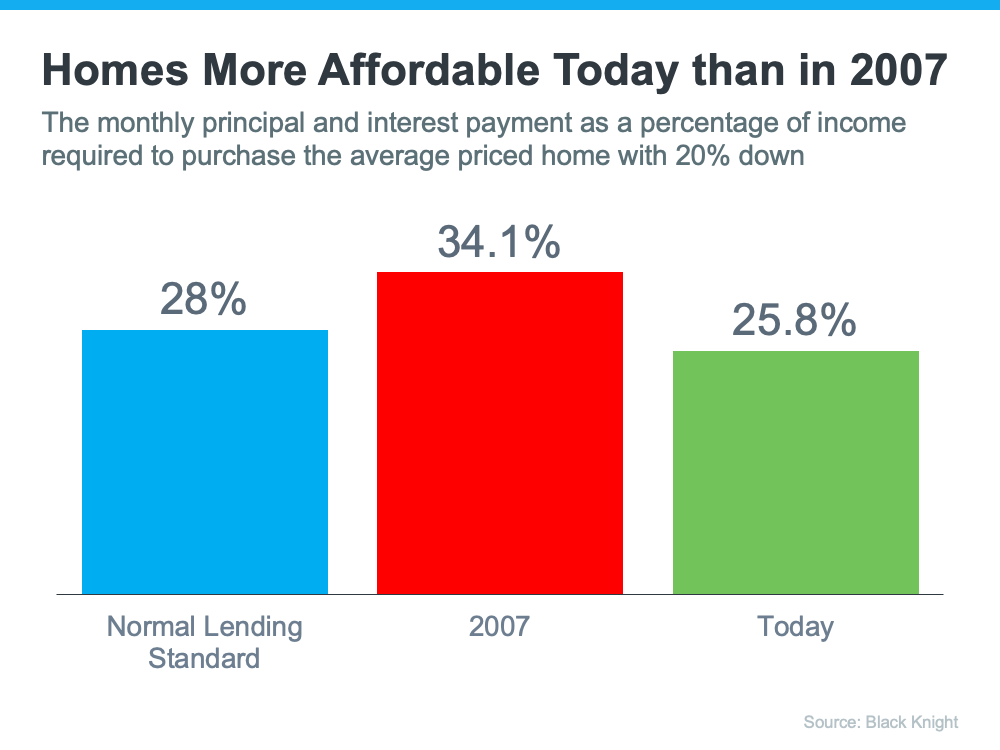
The affordability formula has three components: the price of the home, wages earned by the purchaser, and the mortgage rate available at the time. Conventional lending standards say a purchaser should not spend more than 28% of their gross income on their mortgage payment.

Fifteen years ago, prices were high, wages were low, and mortgage rates were over 6%. Today, prices are still high. Wages, however, have increased, and the mortgage rate, even after the recent spike, is still well below 6%. That means the average purchaser today pays less of their monthly income toward their mortgage payment than they did back then.

In the latest Affordability Report by ATTOM Data, Chief Product Officer Todd Teta addresses that exact point:

“The average wage earner can still afford the typical home across the U.S., but the financial comfort zone continues shrinking as home prices keep soaring and mortgage rates tick upward.”

Affordability isn’t as strong as it was last year, but it’s much better than it was during the boom. Here’s a chart showing that difference:
4 Simple Graphs Showing Why This Is Not a Housing Bubble | Simplifying The Market

If costs were so prohibitive, how did so many homes sell during the housing boom?

2. Mortgage Standards Were Much More Relaxed During the Boom

During the housing bubble, it was much easier to get a mortgage than it is today. As an example, let’s review the number of mortgages granted to purchasers with credit scores under 620. According to credit.org, a credit score between 550-619 is considered poor. In defining those with a score below 620, they explain:

“Credit agencies consider consumers with credit delinquencies, account rejections, and little credit history as subprime borrowers due to their high credit risk.”

Buyers can still qualify for a mortgage with a credit score that low, but they’re considered riskier borrowers. Here’s a graph showing the mortgage volume issued to purchasers with a credit score less than 620 during the housing boom, and the subsequent volume in the 14 years since.

4 Simple Graphs Showing Why This Is Not a Housing Bubble | Simplifying The Market

Mortgage standards are nothing like they were the last time. Purchasers that acquired a mortgage over the last decade are much more qualified. Let’s take a look at what that means going forward.

3. The Foreclosure Situation Is Nothing Like It Was During the Crash

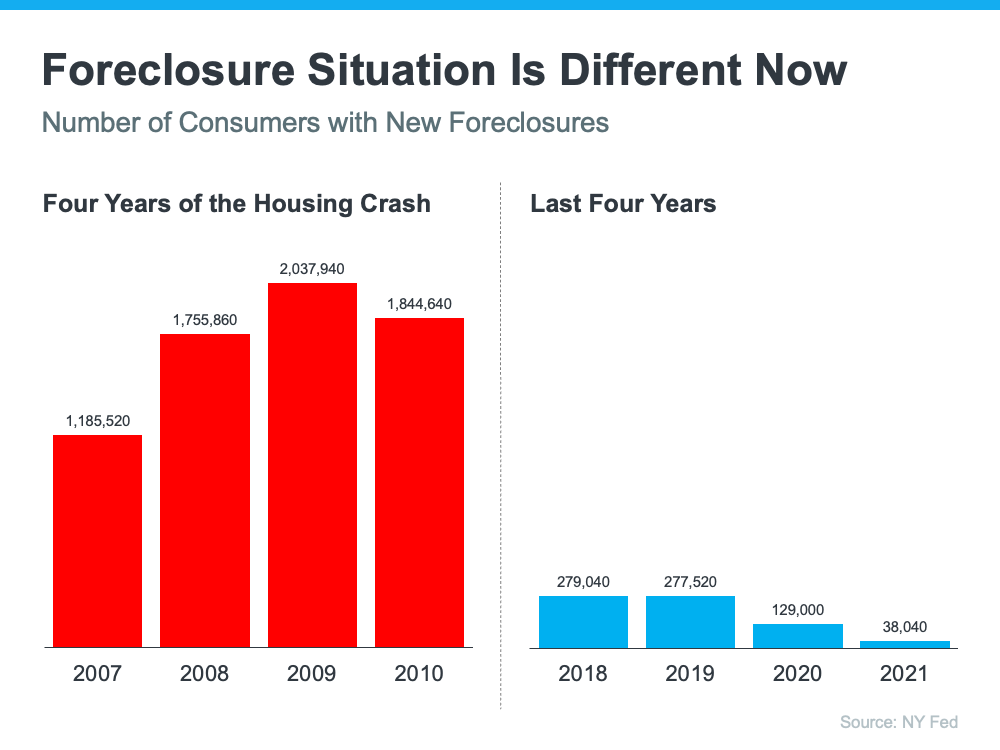
The most obvious difference is the number of homeowners that were facing foreclosure after the housing bubble burst. The Federal Reserve issues a report showing the number of consumers with a new foreclosure notice. Here are the numbers during the crash compared to today:
4 Simple Graphs Showing Why This Is Not a Housing Bubble | Simplifying The Market

There’s no doubt the 2020 and 2021 numbers are impacted by the forbearance program, which was created to help homeowners facing uncertainty during the pandemic. However, there are fewer than 800,000 homeowners left in the program today, and most of those will be able to work out a repayment plan with their banks.

Rick Sharga, Executive Vice President of RealtyTrac, explains:

“The fact that foreclosure starts declined despite hundreds of thousands of borrowers exiting the CARES Act mortgage forbearance program over the last few months is very encouraging. It suggests that the ‘forbearance equals foreclosure’ narrative was incorrect.”

Why are there so few foreclosures now? Today, homeowners are equity rich, not tapped out.

In the run-up to the housing bubble, some homeowners were using their homes as personal ATM machines. Many immediately withdrew their equity once it built up. When home values began to fall, some homeowners found themselves in a negative equity situation where the amount they owed on their mortgage was greater than the value of their home. Some of those households decided to walk away from their homes, and that led to a rash of distressed property listings (foreclosures and short sales), which sold at huge discounts, thus lowering the value of other homes in the area.

Homeowners, however, have learned their lessons. Prices have risen nicely over the last few years, leading to over 40% of homes in the country having more than 50% equity. But owners have not been tapping into it like the last time, as evidenced by the fact that national tappable equity has increased to a record $9.9 trillion. With the average home equity now standing at $300,000, what happened last time won’t happen today.

As the latest Homeowner Equity Insights report from CoreLogic explains:

“Not only have equity gains helped homeowners more seamlessly transition out of forbearance and avoid a distressed sale, but they’ve also enabled many to continue building their wealth.”

There will be nowhere near the same number of foreclosures as we saw during the crash. So, what does that mean for the housing market?

4. We Don’t Have a Surplus of Homes on the Market – We Have a Shortage

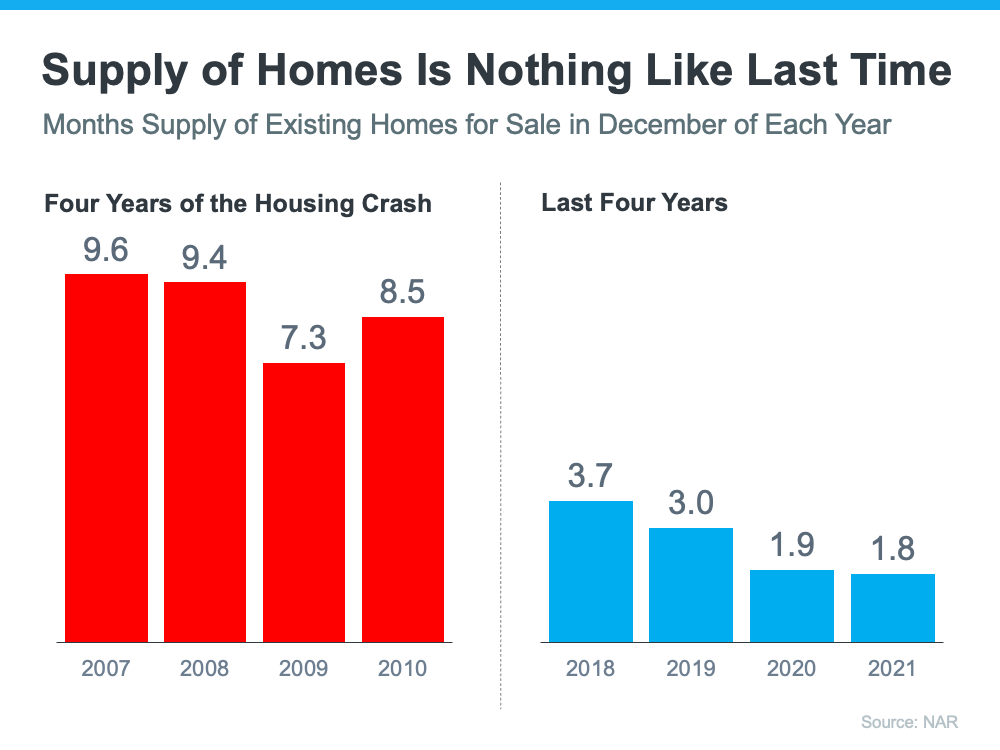
The supply of inventory needed to sustain a normal real estate market is approximately six months. Anything more than that is an overabundance and will causes prices to depreciate. Anything less than that is a shortage and will lead to continued price appreciation. As the next graph shows, there were too many homes for sale from 2007 to 2010 (many of which were short sales and foreclosures), and that caused prices to tumble. Today, there’s a shortage of inventory, which is causing the acceleration in home values to continue.
4 Simple Graphs Showing Why This Is Not a Housing Bubble | Simplifying The Market

Inventory is nothing like the last time. Prices are rising because there’s a healthy demand for homeownership at the same time there’s a shortage of homes for sale.

Bottom Line

If you’re worried that we’re making the same mistakes that led to the housing crash, the graphs above show data and insights to help alleviate your concerns.

More People Are Planning To Buy a Home Soon

Posted by

More People Are Planning To Buy a Home Soon | Simplifying The Market

While some homeowners may be tempted to hold off until spring to list their houses, you should know – homebuyers aren’t waiting. Demand is high today as more people are trying to beat rising mortgage rates. As a result, eager buyers are entering the market or moving their plans up so they can make their purchases as soon as possible.

The most recent Consumer Confidence Survey finds that, of those surveyed, the percentage of people planning to buy over the next six months has increased substantially since last fall (see graph below):

More People Are Planning To Buy a Home Soon | Simplifying The Market

As the graph shows, the number of consumers fast-tracking their plans to purchase a home has crept up over the past three months. That indicates many buyers are evaluating their strategy and realizing they should act sooner rather than later. And for homeowners planning to sell, it’s a signal that now may be the time to list.

While more people are moving their plans up, others are actively putting theirs in motion. Time on the market is a great indication that homebuyers are motivated and moving quickly. According to a recent realtor.com report, the average home sold faster this January than any January on record.

Danielle Hale, Chief Economist at realtor.com, notes:

“Homes sold at a record-fast January pace, suggesting that buyers are more active than usual for this time of year.”

What Does That Mean for You?

Homebuyers are rethinking their strategies and moving their plans forward. Others are making their moves today. That means demand for your house isn’t just increasing – it’s high right now.

And because there are so few homes available for determined purchasers to choose from, if you’re planning to sell your house this year, doing so sooner means you can take advantage of high buyer demand before more houses are listed in your neighborhood. Why is this important? Because as more houses are put up for sale, buyers will have more options. But until then, your house will be in the spotlight.

Bottom Line

With so many buyers eager to make a purchase, you could benefit by listing your house soon. To understand how strong buyer demand is in our area, let’s connect so you can start making your plans today.

Want Top Dollar for Your House? Now’s the Time To List It.

Posted by

Want Top Dollar for Your House? Now’s the Time To List It. | Simplifying The Market

When you’re selling any item, you usually want to sell it for the greatest profit possible. That happens when there’s a strong demand and a limited supply for that item. In the real estate market, that time is right now. If you’re thinking of selling your house this year, here are two reasons why now’s the time to list.

1. Demand Is Very Strong This Winter

A recent article in Inman News explains:

“Spring, the hottest time of year for homebuyers and sellers, has started early, according to economists. . . . ‘Home shopping season appears to already be in full swing!’”

And they aren’t the only ones saying buyers are already out in full force. That claim is backed up with data released last week by ShowingTime. The ShowingTime Showing Index tracks the average number of monthly buyer showings on active residential properties, which is a highly reliable leading indicator of current and future trends for buyer demand. The latest index reveals this December was the most active December in five years (see graph below):

Want Top Dollar for Your House? Now’s the Time To List It. | Simplifying The Market

As the data indicates, buyers are very active this winter. Last December saw even more showings than December of 2020, which was already a stronger-than-usual winter. And remember – you want to sell something when there’s a strong demand for that item. That time is now.

2. Housing Supply Is Extremely Low

Each month, realtor.com releases data on the number of active residential real estate listings (listings currently for sale). Their most recent report reveals the latest monthly number is the lowest we’ve seen in any January since 2017 (see graph below):

Want Top Dollar for Your House? Now’s the Time To List It. | Simplifying The Market

And don’t forget, the best time to sell an item is when there’s a limited supply of it available. This graph clearly shows how extremely low housing supply is today.

Even Though Supply Is at a Historic Low, Home Sales Are at a 15-Year High

According to the latest Existing Home Sales Report from the National Association of Realtors (NAR), existing-home sales totaled 6.12 million in 2021 – the highest annual level since 2006. This means the market is hot and homeowners are in a great place to sell now while sales are so strong.

NAR also reports available listings by calculating the current months’ supply of inventory. They explain:

“Months’ supply refers to the number of months it would take for the current inventory of homes on the market to sell given the current sales pace.”

The current 1.8-months’ supply is the lowest ever reported. Here are the December numbers over the last five years (see graph below):

Want Top Dollar for Your House? Now’s the Time To List It. | Simplifying The Market

The ratio of buyers to sellers favors homeowners right now to a greater degree than at any other time in history. Buyer demand is high, and supply is low. That gives sellers like you an incredible opportunity.

Bottom Line

If you agree the best time to sell anything is when demand is high and supply is low, let’s connect to begin discussing the process of listing your house today.

The Path To Homeownership Can Be Steeper for Some Americans

Posted by

The Path To Homeownership Can Be Steeper for Some Americans | Simplifying The Market

As we celebrate Black History Month, we honor and recognize the past and present experiences of Black Americans. A significant part of this experience is investing in a home of their own. While equitable access to housing has come a long way, the path to homeownership is still steeper for households of color. It’s an important experience to talk about, along with how working with the right real estate experts can make all the difference for diverse homebuyers.

We know it’s a more challenging journey to achieve homeownership for some because there’s still a measurable gap between the overall average U.S. homeownership rate and that of non-white groups. Today, the lowest homeownership rate persists in the Black community (see graph below):

The Path To Homeownership Can Be Steeper for Some Americans | Simplifying The Market

Homeownership is an essential piece for building household wealth that can be passed down to future generations. However, there are obstacles in the homebuying process that can negatively impact certain racial and ethnic groups, including the Black community. This can delay or prevent many from achieving homeownership, challenging their ability to grow their net worth. A report by Vanessa G. Perry of the George Washington University School of Business and Janneke Ratcliffe of the Urban Institute explains:

“. . . households of color have much lower homeownership rates than white households and consequently hold, at the median, just one-eighth the wealth of white households.”

On top of that, when Black households do become homeowners, research shows they pay more for those homes overall than the average household. Raheem Hanifa, a Research Analyst for the Joint Center for Housing Studies of Harvard University, tells us:

“Black homeowners not only have primary mortgages with higher interest rates than white homeowners with similar incomes, they also have higher interest rates than white homeowners with substantially lower incomes, . . . Black homeowners have experienced systemic barriers to homeownership and wealth-building opportunities that have limited their ability to access credit, which is a key component in receiving low mortgage interest rates.”

For Black homebuyers, the inequity that remains in housing can be a point of pain and frustration. That’s why it’s so important for members of diverse groups to have the right team of experts on their sides throughout the homebuying process. These professionals aren’t only experienced advisors who understand the market and give the best advice. They’re also compassionate allies who will advocate for your best interests every step of the way.

Bottom Line

Opportunities in real estate improve every day, but there are still equity challenges that many face. Let’s connect to make sure you have an advocate on your side as you walk the path to homeownership.

Consumers Agree: It’s a Good Time To Sell

Posted by

Consumers Agree: It’s a Good Time To Sell | Simplifying The Market

In today’s sellers’ market, many homeowners are weighing their options and trying to decide if they should sell their house. If you’re in that group, you may be balancing things like the ongoing health crisis, rising mortgage rates, and your own changing needs to determine your best time to make a move.

However, recent data shows that time may already be here. According to the latest Home Purchase Sentiment Index (HPSI) by Fannie Mae, 76% of consumers believe now is a good time to sell.

Looking back over the past few years, its clear consumers are incredibly optimistic today. The graph below shows the percent of survey respondents who say it’s a good time to sell a house, and their positive outlook is on the rise. The big dip near the middle of the chart indicates how consumer sentiment about selling dropped at the beginning of the pandemic as uncertainty about the health crisis and its impact grew. The good news is, the trend today shows a continued, drastic improvement, and people are feeling more and more confident with time about selling a home.

In fact, survey respondents think it’s an even better time to sell a house today than they did in the lead-up to the health crisis. The latest survey results indicate we’re at one of the strongest peaks in seller sentiment since March of 2019, hitting highs when 77% of people thought it was a good time to sell only twice before in June and October of 2021.

Consumers Agree: It’s a Good Time To Sell | Simplifying The Market

Why Are Consumers So Optimistic About Today’s Housing Market?

From record-high equity gains to record-low housing supply and significant buyer demand, homeowners have more motivation than ever to sell. There are more buyers in today’s market than there are homes for sale, and that’s driving home prices up, making it a great time to sell your house.

According to the National Association of Realtors (NAR), the current supply of homes for sale today is at a 1.8-month supply, which is an all-time low. When the supply of homes for sale is low, sellers will likely see more offers, which is exactly what’s happening right now. As NAR notes:

“The average home for sale is receiving 3.8 offers today, up from 3.3 offers just one year ago.”

Bottom Line

With the inventory of houses for sale so low today pushing home prices in an upward direction, it’s no wonder consumers think it’s a good time to sell. If you’re ready to take advantage of today’s favorable sellers’ market, let’s connect today.

Why Right Now Is a Once-in-a-Lifetime Opportunity for Sellers

Posted by

Why Right Now Is a Once-in-a-Lifetime Opportunity for Sellers | Simplifying The Market

If you’re thinking about selling your house in 2022, you truly have a once-in-a-lifetime opportunity at your fingertips. When selling anything, you always hope for strong demand for the item coupled with a limited supply. That maximizes your leverage when you’re negotiating the sale. Home sellers are in that exact situation right now. Here’s why.

Demand Is Very Strong

According to the latest Existing Home Sales Report from the National Association of Realtors (NAR), 6.18 million homes were sold in 2021. This was the largest number of home sales in 15 years. Lawrence Yun, Chief Economist for NAR, explains:

“Sales for the entire year finished strong, reaching the highest annual level since 2006. . . . With mortgage rates expected to rise in 2022, it’s likely that a portion of December buyers were intent on avoiding the inevitable rate increases.”

Demand isn’t expected to weaken this year, either. In addition, the Mortgage Finance Forecast, published last week by the Mortgage Bankers’ Association (MBA), calls for existing-home sales to reach 6.4 million homes this year.

Supply Is Very Limited

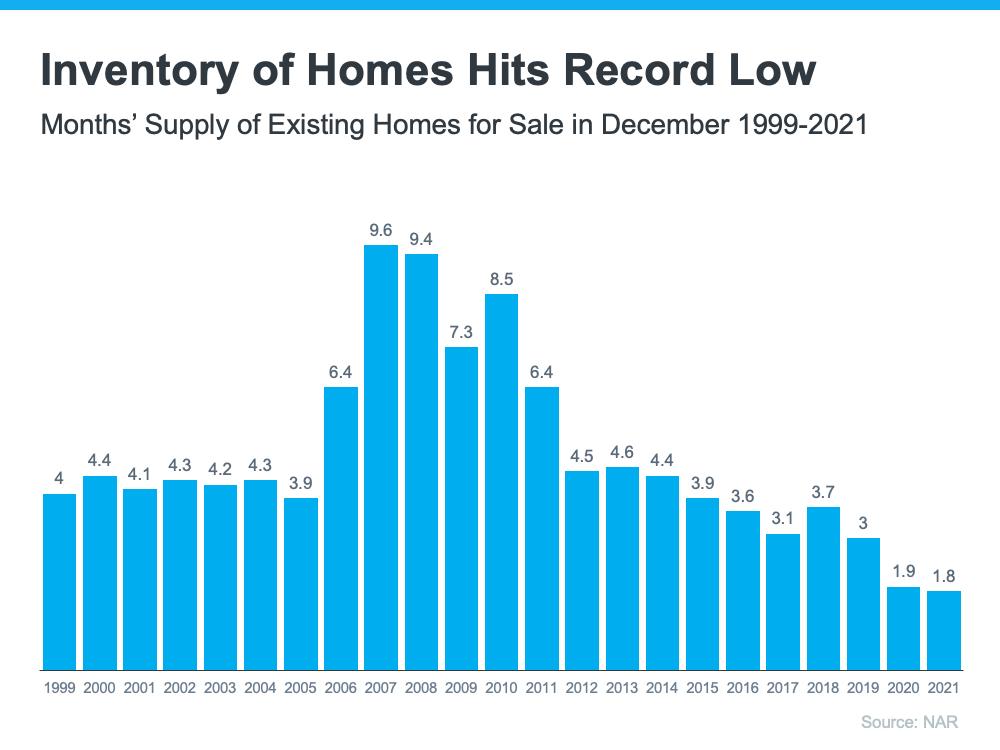
The same sales report from NAR also reveals the months’ supply of inventory just hit the lowest number of the century. It notes:

“Total housing inventory at the end of December amounted to 910,000 units, down 18% from November and down 14.2% from one year ago (1.06 million). Unsold inventory sits at a 1.8-month supply at the present sales pace, down from 2.1 months in November and from 1.9 months in December 2020.”

The reality is, inventory decreases every year in December. That’s just how the typical seasonal trend goes in real estate. However, the following graph emphasizes how this December was lower than any other December going all the way back to 1999.

Why Right Now Is a Once-in-a-Lifetime Opportunity for Sellers | Simplifying The Market

Right Now, Sellers Have Maximum Leverage

As mentioned above, when there’s strong demand for an item and a limited supply of it available, the seller has maximum leverage in the negotiation. In the case of homeowners who are thinking about selling, there may never be a better time than right now. While demand is this high and inventory is this low, you’ll have leverage in all aspects of the sale of your house.

Today’s buyers know they need to be flexible negotiators that make very competitive offers, so here are a few areas that could tip in your favor when your house goes on the market:

  • Competitive sales price
  • Flexible closing date
  • Potential for a leaseback to allow you more time to find a home
  • Minimal offer contingencies

Bottom Line

If you’re thinking of selling your house this year, now is the optimal time to list it. Let’s connect to discuss how you can put your house on the market today.

Are You a Homeowner Thinking About Climate Change?

Posted by

Are You a Homeowner Thinking About Climate Change? | Simplifying The Market

Americans are more aware than ever of the effects climate change and natural disasters can have on their homes. According to a report from realtor.com:

More than 3 in 4 recent buyers, 78%, took [natural disasters] into account when choosing the locations of their homes, . . .”

The study also found that many existing homeowners (34%) have already considered selling their houses and moving to a new location because of the changing climate. If you’re like those homeowners and are weighing your options about what to do next, here’s some information to keep in mind as you begin the process of selling your existing house and searching for your new home.

Do Your Research and Work with a Real Estate Advisor To Find a Home That Meets Your Needs

As a homeowner, it’s impossible to control what types of weather events your home is exposed to. As Maiclaire Bolton Smith, Senior Leader of Research and Content Strategy for CoreLogic, says:

“You can’t necessarily remove the location from around you, but there are things you can do to mitigate damage that can happen.”

The first step is understanding how to navigate your home sale and purchase with these specific issues in mind. While that can seem like a difficult undertaking at first, with the appropriate resources and experts on your side, you can simplify the process.

The Mortgage Reports provides some tips for purchasing your next house, including, but not limited to:

  • Vetting the location before you buy
  • Researching Climate Action Plans and learning if the city or state has one
  • Working with professionals for additional assessments on the home’s ability to withstand natural disasters

Ultimately, your best resource throughout the process is a trusted real estate professional. An agent will help you navigate the sale and required disclosures for your existing home, be your expert advisor on local guidelines and information, and keep your goals and concerns top of mind. Even if your advisor doesn’t have the answers to all your questions about how your next home will stand up to natural disasters, they can help connect you with experts and resources who will.

Bottom Line

If you’re becoming more mindful about the effects of climate change and you’re ready to make a move, you’re not alone. Let’s connect so you have a trusted advisor on your side to help you navigate the sale of your current house and find the perfect spot for your next home.